

Probing Individual Atomic-Scale Spins via Magnetic Exchange Force Microscopy
Lovis Hardeweg — Hector RCD Awardee Philip Willke
During the overall pursuit of stable and application-ready quantum computing, this project does basic research on the fundamental building blocks of quantum computers, the qbits. We are using Scanning Probe Microscopy (SPM) to investigate individual atoms and molecules on surfaces in their potential role as spin qbits. Specifically, this project investigates how the coherence, an important quality metric for qbits, is affected by the environment.
What constitutes a good qbit, the fundamental building block of quantum computers? And what happens when you make them microscopically small? These are questions our project is trying to answer.
We are investigating atomic-scale spin qbits made up of individual magnetic atoms or molecules.To be able to do quantum physics at this length scale, we use Scanning Probe Microscopy (SPM) at ultra low temperatures (30 mK). Using Scanning Tunneling Microscopy (STM), the control of this kind of qbit has already been established, but is limited by the large number of electrons in the environment. These electrons in the conductive sample and tip required for STM are limiting the life- and coherence time of qbits.
That is where my PhD project comes in: What if we could also control these spin qbits using Atomic Force Microscopy (AFM) which does not need conductive samples to operate? With this aim in mind, I am setting up and developing an quantum platform for atomic-scale spin qbits which I want to compare to those already measured using STM.
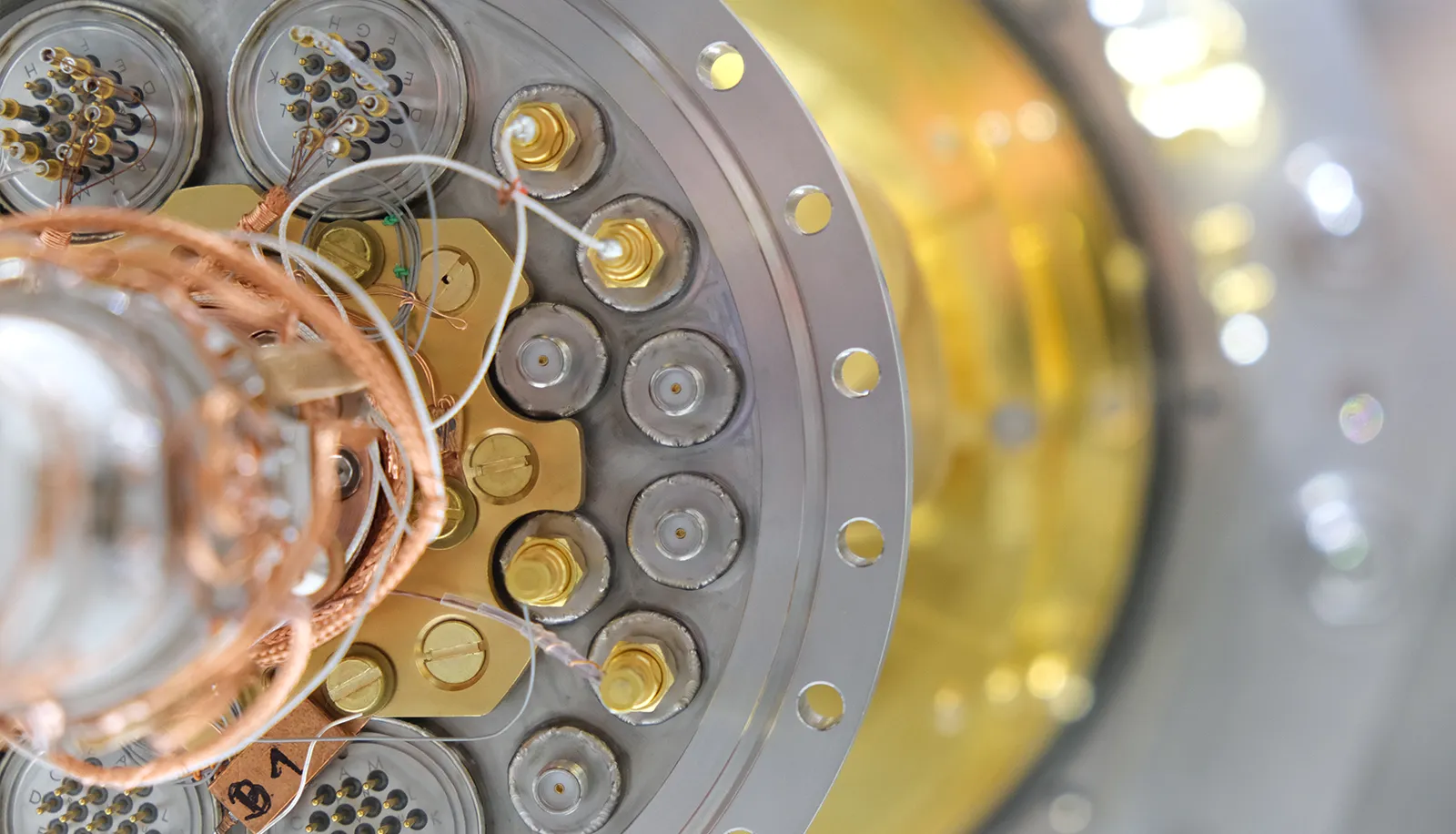
Part of our experimental setup: Scanning Probe Microscopy head (left) attached to the mixing chamber (center) of our compact dilution cryostat with the warmer stages of the cryostat in the background (right).

Lovis Hardeweg
Karlsruhe Institute of Technology (KIT)
Supervised by

Philip Willke
Physics, Chemistry Hector RCD Awardee since 2022