

Machine Learning Models For Gravitational Waves Analysis
Mateusz Kapusta — Hector RCD Awardee Maximilian Dax
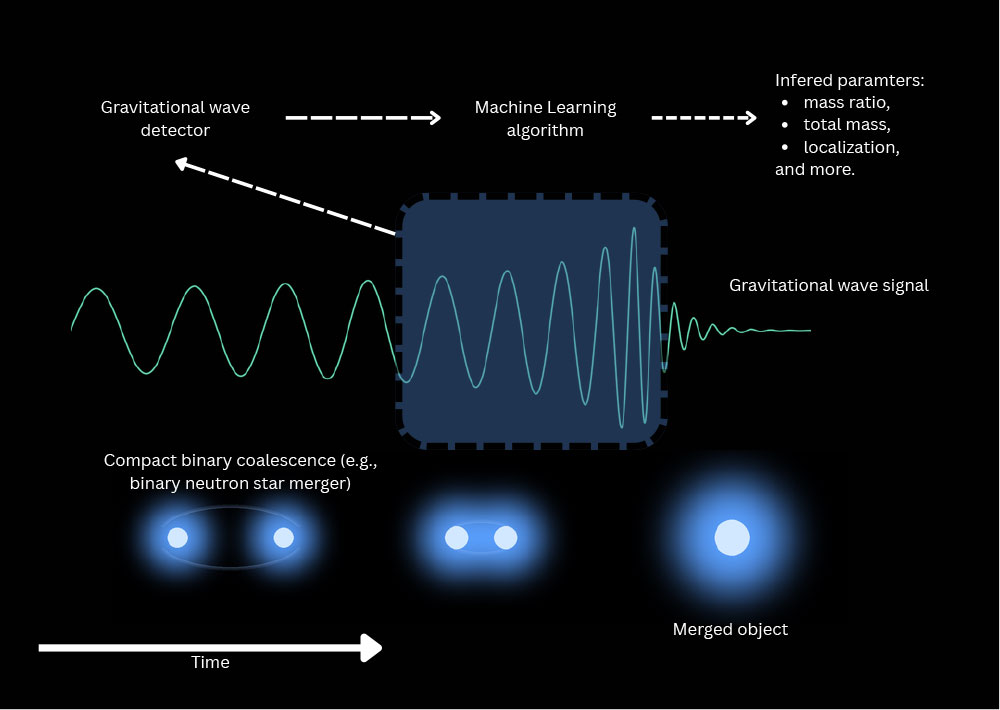
Modern gravitational-wave observatories such as LIGO, Virgo, and KAGRA, along with future projects like LISA, are essential tools for understanding the physical processes occurring throughout our Universe. However, the complexity and sheer volume of their data make analysis computationally demanding. My PhD research aims to streamline the analysis of data from these observatories by leveraging modern machine learning techniques, including Simulation-Based Inference (SBI).
Observations of gravitational waves took the physics world by storm following the first detection in 2016. Since then, LIGO, Virgo, and KAGRA have allowed us to probe various areas of physics, including general relativity, cosmology, and stellar astrophysics. These advances rely on the analysis and characterization of signals measured by the observatories. However, processing these signals is computationally expensive and can become a significant bottleneck in the analysis pipeline.
Recent advances in machine learning have given rise to a plethora of domain-specific applications. One such technique is Simulation-Based Inference (SBI), which can accelerate inference for various physical problems by several orders of magnitude while maintaining high accuracy. SBI has already been successfully applied to gravitational-wave analysis by our group, proving the applicability of the framework.
My PhD will focus on developing the SBI framework to better handle real-world datasets, including missing data and other imperfections. We also aim to extend these methods to upcoming gravitational-wave observatories such as LISA. Ultimately, we want to make SBI models more capable, flexible, and easier to use without sacrificing performance or accuracy, providing a foundation for more efficient gravitational-wave analysis.
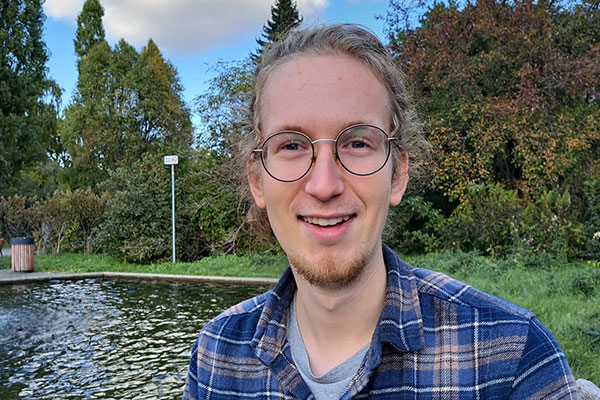
Mateusz Kapusta
ELLIS Institute Tübingen and Max Planck Institute for Intelligent Systems
Supervised by
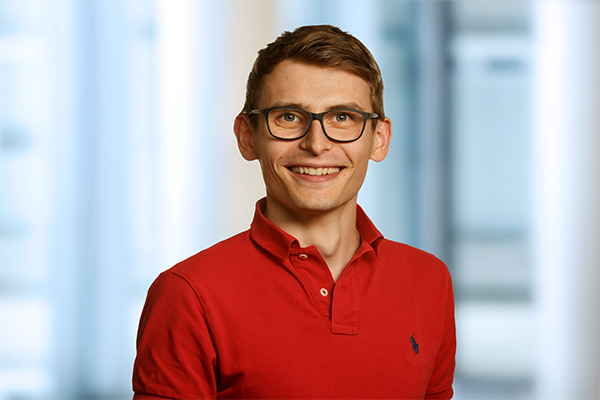
Maximilian Dax
Informatics, Physics, MathematicsHector RCD Awardee since 2025