

One Ring to Light Them All: Decoding Single-Benzene Emitters
Shi Hui Wong — Hector RCD Awardee Carolin Müller
Photoactive molecules with precisely tunable absorption and emission properties play a key role in fields such as photocatalysis and green synthesis. While this tuning is conventionally achieved by altering the length of the π‑conjugated chromophore, we exploit donor-acceptor substitution in compact aromatic building blocks to achieve this tuning and to understand how these molecules drive specific photochemical processes.
Photoactive molecules with precisely tailored absorption and emission properties are key enablers for applications in photocatalysis, green synthesis and light-driven energy conversion. While spectral tuning is conventionally achieved by extension of π‑conjugated systems, our research explores an alternative strategy based on donor-acceptor substitution of compact aromatic building blocks, such as single-benzene fluorophores. These provide an ideal platform for investigating how electronic structure governs light absorption, excited-state dynamics, and emission.
To uncover these relationships, we combine quantum chemical simulations with methods from digital chemistry, including high-throughput screening and data-driven structure-property analysis. This enables us to elucidate ultrafast photophysical processes determining fluorescence and to derive predictive design rules for tailoring molecular function. Rather than optimizing individual compounds by trial and error, we aim to establish transferable principles for the discovery of new photoactive molecules with targeted optical properties.
In collaboration with synthetic and spectroscopic partners, theoretical predictions are translated into new molecular designs and experimentally validated. By integrating quantum chemistry, digital chemistry, synthesis and spectroscopy, we seek to establish compact molecular fluorophores as a versatile platform for novel light-responsive materials and selective photochemical transformations.
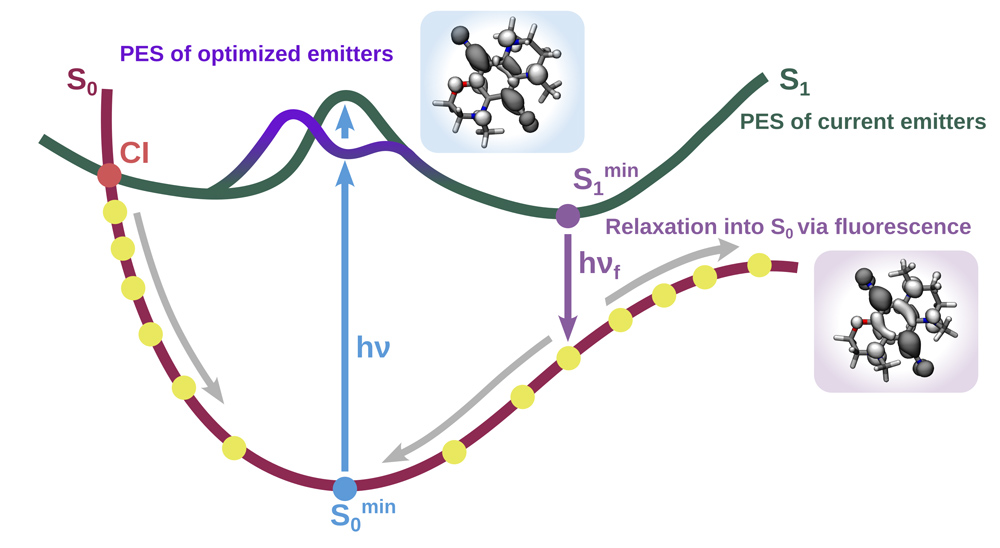
Schematic illustration of potential energy surfaces of the two lowest lying singlet states of a fluorophore and its key photophysical processes. Absorption and fluorescence are indicated by colored arrows, while non-radiative processes are depicted by gray arrows.

Shi Hui Wong
Friedrich-Alexander-Universität Erlangen-Nürnberg
Supervised by

Carolin Müller
Chemistry, Informatics Hector RCD Awardee since 2024