

Beyond Retinal: Machine Learning Models for Photochemical Control in Rhodopsins
Hector RCD Awardee Prof. Dr. Carolin Müller
Hector Fellow Prof. Dr. Klaus Robert Müller
Hector Fellow Prof. Dr. Peter Hegemann
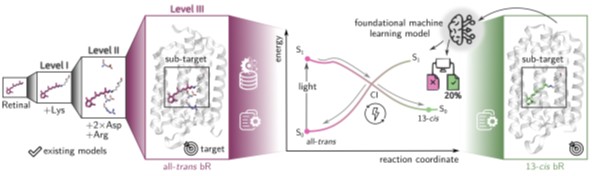
A deep understanding of these interactions is essential for deciphering the molecular principles of biological light perception and for specifically controlling photochemical reactivity. Experimental methods such as time-resolved UV/Vis and Raman spectroscopy provide valuable data, but the ultrafast dynamic processes complicate their interpretation and often lead to speculative structure-property relationships. Quantum-theoretical simulations of the excited state offer mechanistic insights, but are practically inaccessible for the large chromophore-protein complexes of rhodopsins.
This project addresses this limitation by developing a machine learning (ML) framework that describes excited states in covalently bonded systems and uses rhodopsins as a model. The project brings together the expertise of Prof. Dr. Klaus Robert Müller (machine learning for chemistry and physics), Prof. Dr. Carolin Müller (high-quality QM/MM data and extension of ML models for excited states), and Prof. Dr. Peter Hegemann (synthetic, expressed, and spectroscopically characterized rhodopsin derivatives). The combination of mass-selective ion soft landing and ESR STM represents a groundbreaking methodological advancement that provides a modular platform for the controlled assembly of arbitrary molecular building blocks and their spin coupling, and can be seamlessly extended to larger biomolecules (e.g., metal proteins). In the long term, an open toolset will be created for the scientific community that links elementary surface physics with quantum information and sensor technology, laying the foundation for the next generation of molecular quantum simulators and optogenetic tools.
Tomáš Grycz
Friedrich-Alexander-Universität Erlangen-NürnbergSupervised by
Carolin Müller
Chemistry, Informatics Hector RCD Awardee since 2024
Klaus-Robert Müller
Informatics, Mathematics & PhysicsHector Fellow since 2023
Peter Hegemann
Biology, Chemistry & MedicineHector Fellow since 2015