

Swarm Behaviour and Cardiac Regeneration in Focus
Hector Science Awards of the Weinheim-based Hector Foundation go to biologist Iain Couzin and cardiovascular researcher Stefanie Dimmeler
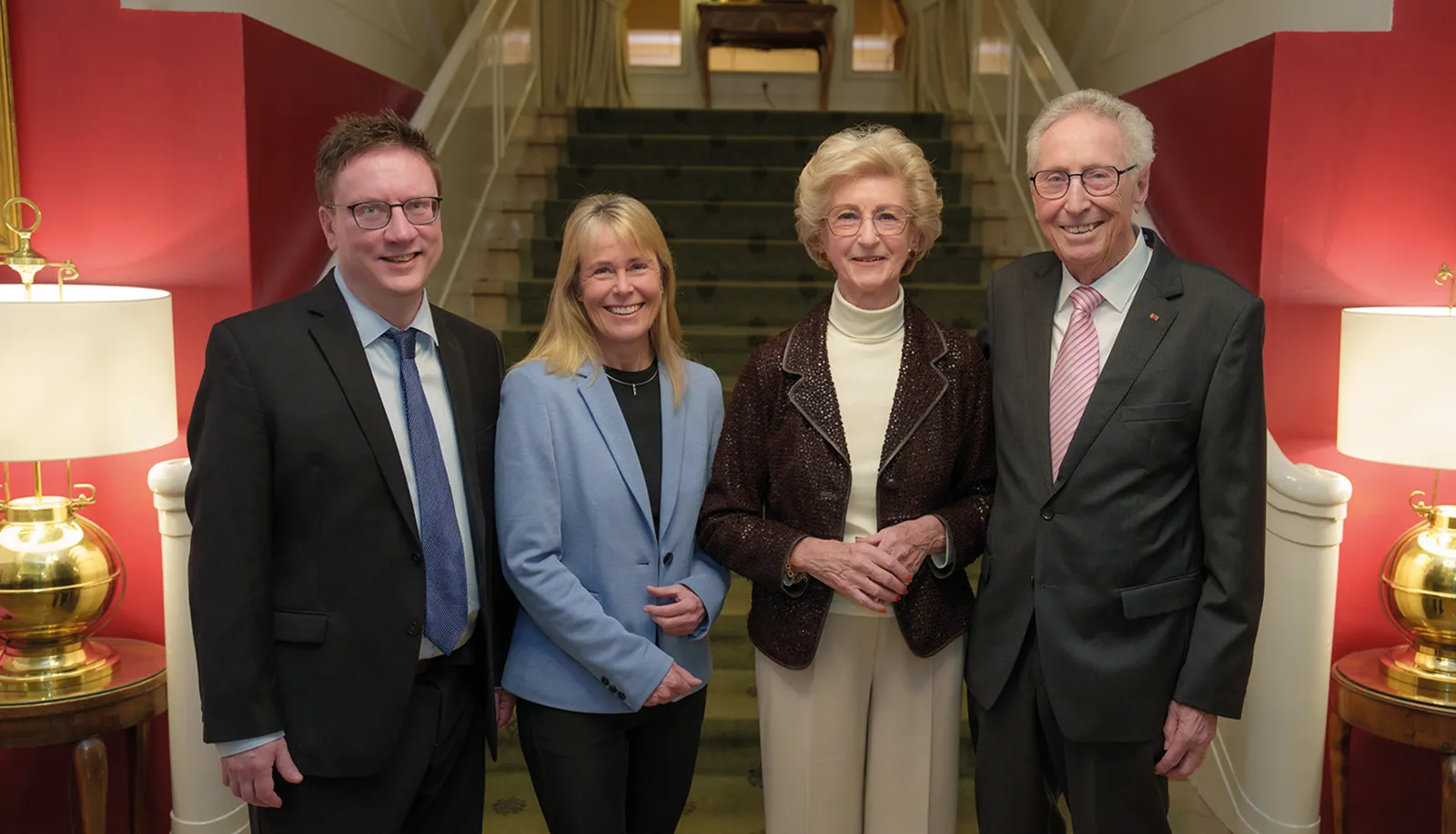
Prof. Dr. Iain Couzin and Prof. Dr. Stefanie Dimmeler receive this year’s Hector Science Award of the Weinheim-based Hector Foundation, endowed with €200,000 each. The photograph shows them together with the founders Josephine and Dr. h.c. Hans-Werner Hector (from left). Photo credit: Marco Schilling
Weinheim.This year, Prof. Dr. Iain Couzin and Prof. Dr. Stefanie Dimmeler are being awarded the Hector Science Award of the Weinheim-based Hector Foundation, endowed with €200,000 each. With this distinction, the jury honours the outstanding scientific achievements of the British biologist, who researches the mechanisms of collective behaviour at the University of Konstanz and the Max Planck Institute of Animal Behavior, as well as those of the biologist and biochemist who is developing new approaches to repairing damaged hearts at Goethe University Frankfurt.
As part of the Hector Foundations' 30th anniversary celebrations, Uwe Bleich, member of the Executive Board, welcomed all guests in attendance. In his speech, he warmly thanked the founders Josephine and Hans-Werner Hector and emphasized that since its establishment, the Hector Foundation has been guided by the central idea that entrepreneurial success creates a responsibility for education, science, health, culture, and social participation.
Uwe Bleich then welcomed Prof. Dr. Iain Couzin and Prof. Dr. Stefanie Dimmler as new award winners to the circle of Hector Fellows. In their laudatory speeches, Prof. Dr. Ralph Bartenschlager and Prof. Dr. Dr. Christoph Klein unanimously emphasized that the big questions of our time cannot be answered within individual disciplines, but only through interdisciplinary collaboration. In addition to highly innovative and visionary research, this requires scientists who are willing to take responsibility. With these qualities, the two award winners are an ideal fit for the interdisciplinary network of the Hector Fellow Academy.
Prof. Dr. Iain D. Couzin FRS is Director at the Max Planck Institute of Animal Behavior and Professor of Biodiversity and Collective Behaviour at the University of Konstanz. He also serves as spokesperson for the Centre for the Advanced Study of Collective Behaviour at the University of Konstanz, funded by the German Research Foundation (DFG). Internationally, he is regarded as one of the leading experts in the field of animal collective behaviour and investigates how remarkably complex group patterns emerge from simple behavioural rules of individual animals—and how such groups make collective decisions.
By employing automated tracking, computer-based image analysis, theoretical models—such as the so-called “Couzin model”—and robotics, Couzin and his team are able to precisely quantify the dynamics of fish schools and insect colonies in laboratory and natural environments, as well as large animal herds, such as zebras, in the wild. His work has fundamentally shaped the understanding of collective behaviour, demonstrating how information spreads within animal groups, how leadership roles emerge spontaneously, and how swarms respond to environmental changes.
Iain Couzin’s research exemplifies the establishment of modern quantitative behavioural biology and represents a lasting contribution to the understanding of collective systems.
Prof. Dr. Stefanie Dimmeler is Professor of Molecular Cardiology at Goethe University Frankfurt and Chair of the Board of the German Centre for Cardiovascular Research (DZHK), as well as spokesperson for the DFG-funded Cluster of Excellence Cardio-Pulmonary Institute. She is among the internationally renowned researchers in the field of cardiovascular diseases and is one of the most highly cited scientists in Germany across disciplines. Her research focuses on the cellular and molecular mechanisms that contribute to the loss of heart and vascular cells—for example following myocardial infarction—and on how these insights can be translated into novel regenerative therapies.
A particular focus of her work lies on non-coding RNAs—small “switches” within our cells that regulate gene activity—as well as on endogenous repair mechanisms for damaged tissue. Together with her team, Stefanie Dimmeler has demonstrated how the inner lining of blood vessels (the endothelium) is regulated and how vascular protection and healing processes can be selectively enhanced, including the mitigation of premature cardiac ageing. Her research has thus advanced new cellular and pharmacological approaches for the regeneration of the heart and vasculature and established non-coding RNAs as potential targets for future therapies.
Stefanie Dimmler's work impressively demonstrates how findings from molecular research can be translated into concrete clinical applications and incorporated into the development of clinical diagnosis and therapy concepts.
About the Hector Foundations
The H.W. & J. Hector Foundation was established in 1995 by Josephine and Dr. h.c. Hans-Werner Hector in Weinheim an der Bergstraße. In 2008, Hector Foundation II was founded as a complementary institution.
The Foundations support the following core areas:
- Science and Education: Support for talented and highly gifted young people (Hector Children’s Academy, Hector Seminar), particularly in the natural sciences; the Hector Institute for Empirical Educational Research at the University of Tübingen; recognition of outstanding scientists through the Hector Science Award; support of excellent early-career researchers and interdisciplinary projects within the Hector Fellows network of the Hector Fellow Academy; funding of personnel endowments for elite universities. In 2020, for example, the Foundation pledged up to €100 million in support of the “AI Breakthrough Hub” project in Tübingen’s “Cyber Valley,” one of the largest research collaborations for artificial intelligence in Europe.
- Medical Research: Hector Institute for Translational Brain Research (HITBR) in cooperation with the German Cancer Research Center (DKFZ) Heidelberg and the Central Institute of Mental Health (ZI) Mannheim; the DKFZ-Hector Cancer Institute at University Medical Center Mannheim; the Hector Center for Nutrition, Exercise and Sports at Erlangen University Hospital; the Hector Institute for Artificial Intelligence in Psychiatry at the ZI Mannheim (HITKIP).
- Social Projects: Support for initiatives benefiting people with disabilities and socially disadvantaged groups.
- Art and Culture: Including major support for the new building of the Kunsthalle Mannheim (Mannheim Art Museum).
In recognition of their achievements, Josephine and Hans-Werner Hector have received numerous honours, including the Federal Cross of Merit (2003), the Order of Merit of the State of Baden-Württemberg (2014), the Leibniz Medal of the Berlin-Brandenburg Academy of Sciences and Humanities (2017), the Founders’ Award of the Protestant Regional Church and Diakonie Baden (2018), the Bavarian Founders’ Award (2018), and the University Award of the University of Tübingen (2023). In 2003, the University of Karlsruhe awarded Hans-Werner Hector an honorary doctorate. Since December 2011, the couple have been honorary citizens of Weinheim and, since 2024, honorary members of Lebenshilfe Weinheim.
All „Hector Fellows“ at a glance
Award Ceremony 2026: Prof. Dr. Iain Couzin (University of Konstanz and Max Planck Institute of Animal Behavior) and Prof. Dr. Stefanie Dimmeler (Goethe University Frankfurt and German Centre for Cardiovascular Research).
Award Ceremony 2025: Prof. Dr. Stefanie Dehnen (Karlsruhe Institute of Technology) and Prof. Dr. Dr. h.c. Matthias H. Tschöp (Technical University of Munich and Helmholtz Munich).
Award Ceremony 2024: Prof. Dr. Magdalena Götz (Ludwig Maximilian University of Munich and Institute of Stem Cell Research at Helmholtz Munich) and Prof. Dr. Klaus-Robert Müller (Technical University of Berlin and Berlin Institute for the Foundations of Learning and Data).
Award Ceremony 2023: Prof. Dr. Anna Wienhard (Max Planck Institute for Mathematics in the Sciences, Leipzig) and Prof. Dr. Dr. h.c. Christian Haass (Ludwig Maximilian University of Munich).
Award Ceremony 2022: Prof. Dr. Katrin Amunts (Heinrich Heine University Düsseldorf and Forschungszentrum Jülich).
Award Ceremony 2021: Prof. Dr. Patrick Cramer (Max Planck Institute for Biophysical Chemistry, Göttingen; President of the Max Planck Society).
Award Ceremony 2020: Prof. Dr. Wolfgang Wernsdorfer (Karlsruhe Institute of Technology).
Award Ceremony 2019: Prof. Dr. Bernhard Schölkopf (Max Planck Institute for Intelligent Systems, Tübingen).
Award Ceremony 2018: Prof. Dr. Brigitte Röder (University of Hamburg).
Award Ceremony 2017: Prof. Dr. Ralf Bartenschlager (Heidelberg University).
Award Ceremony 2016: Prof. Dr. Peter Hegemann (Humboldt University of Berlin).
Award Ceremony 2015: Prof. Dr. Eva Grebel (Heidelberg University) and Prof. Dr. Dr. Thomas Lengauer (Max Planck Institute for Informatics, Saarbrücken).
Award Ceremony 2014: Prof. Dr. Antje Boetius (University of Bremen), Prof. Dr. Dr. Christoph Klein (Ludwig Maximilian University of Munich), and Prof. Dr. Karl Leo (Technical University of Dresden).
Award Ceremony 2013: Prof. Dr. Immanuel Bloch (Ludwig Maximilian University of Munich), Prof. Dr. Günter M. Ziegler (Free University of Berlin), and Prof. Dr. Dr. h.c. mult. Eberhart Zrenner (University of Tübingen).
Award Ceremony 2012: Prof. Dr. Hilbert von Löhneysen (Karlsruhe Institute of Technology), Prof. Dr. Axel Meyer (University of Konstanz), and Prof. Dr. Nikolaus Pfanner (University of Freiburg).
Award Ceremony 2011: Prof. Dr. A. Stephen K. Hashmi (Heidelberg University), Prof. Dr. Jürg Leuthold (Karlsruhe Institute of Technology), and Prof. Dr. Jens Timmer (University of Freiburg).
Award Ceremony 2010: Prof. Dr. Manfred Kappes (Karlsruhe Institute of Technology), Prof. Dr. Dr. h.c. mult. Franz Nestmann (Karlsruhe Institute of Technology), and Prof. Dr. Thomas Elbert (University of Konstanz).
Award Ceremony 2009: Prof. Dr. Doris Wedlich (†), Prof. Dr. Peter Gumbsch, and Prof. Dr. Martin Wegener (all Karlsruhe Institute of Technology).
Press Release Hector Foundation II, February 2, 2026
Press Contact: Uwe Bleich, Member of the Executive Board, Hector Foundation II, Am Schlossberg 2, 69469 Weinheim
Phone: + 49 (0) 6201 71 08 411
E‑Mail: u.bleich@hector-stiftung.com